Friday, May 8, 2020

Spotlight 12. Heroes

VE Day street party, Attercliffe, Sheffield

History is full of heroes, but they also walk among us. On VE Day we rightly remember the sacrifice of previous generations, but we don’t have to look far, to see acts of heroism all around us today.  
Literature too contains many heroes, all struggling against a monster of some kind, be it physical, ideological, or emotional.  Some fight with a sword, while others battle demons inside themselves.  These stories teach us, not that monsters exist, but that through our heroism, they may be overcome.


Sheffield during WW2

Picture Sheffield is a database of over 100,000 images provided by the City Archives and Local Studies Service.  It contains images relating to Sheffield's rich history from the 12th century to the present day, including large collections on popular themes.

View images of Sheffield during World War Two


Rediscovering the Heroes in England's Medieval Literature

The British Library looks after an astonishing 170 million items including artifacts from every age of written civilisation. Among these treasures are the medieval stories of heroism enjoyed by our ancestors.  Check out the British Library website and discover features on Beowulf, Sir Gawain, and others.

Visit the website


The Big Book Weekend 

The Big Book Weekend runs until the 10th May and brings together the best of the British book festivals cancelled due to coronavirus, featuring the biggest names in books alongside unknown debut authors and rising talents.

Check out the talk this afternoon at 3pm with Michael Morpurgo, author of War Horse and the session this evening  at 7pm about Victor Gregg, one of the last survivors of World War Two.

View the full programme


Creativity during Corona - Heroes

During lockdown, we've been posting daily prompts to spark your creativity.  Claire from Central Library writes,

Often bravery has nothing to do with war, slaying dragons or changing the world. The greatest heroes can be those who defeat the demons within. To celebrate this, I’m turning to the words of one of my poetry heroes, Emily Dickinson, with a poem that I think sums up bravery and resilience whatever battle you are fighting.


Listen to the poem

You could simply read the poems then close…or take a look at the prompts on our Facebook page and send us your own thoughts, notes, journal piece, poem, short story,  drawing, paintings, photographs, knitting, sewing, or  songs….  Enjoy.


How to be a Lion - Drawing Mastervlass with Ed Vere

How to be a Lion is bestseller Ed Vere's powerful picture book story celebrating daydreamers, individuality and the quiet courage to be yourself.  In this video, Ed shows us how to draw Leonard.

Watch the video


Thursday, May 7, 2020

Before the public library: the story of James Woollen of Sheffield and his 'Circulating Library'

Sheffield has a long and diverse library culture spanning back to the 18th century.  Community libraries and book clubs such as The Sheffield Subscription Library (1771-1907), the Vestry Library (1793-c.1839), the Book Society (1806-1944) and the Book Club (1821-1864) thrived for many years as important social institutions in the city.

James Woollen, pictured in the early
19th century (Picture Sheffield: s13683)
One of the movers and shakers in Sheffield’s early library provision was James Woollen, the son of an innkeeper, who ran the ‘Circulating Library’ on Market Street in 1791.  This early venture failed, resulting in his bankruptcy, but undeterred, he moved to High Street where he ran a successful bookshop and stationers, as well as a library.  He is listed in the 1797 Sheffield Directory as: ‘James Woollen, bookseller, stationer, hardwareman, toyman and keeper of the British Circulating Library. 32 High Street.’ 

His premises were low and gloomy, with a little chamber at the back used by the famous Sheffield sculptor, Francis Chantrey, when he was an apprentice to Mr Ramsay, a carver and gilder of High Street.  A catalogue of 1806 (at Sheffield Local Studies Library) shows he also sold maps, sealing wax, ink-pots and lottery tickets!

Library members paid a subscription of 14 shillings a year and could change their books up to 4 times a week.  They were invited to send a list of between 10 and 14 books 'to avoid disappointment'.  Non-members could borrow the cheapest publications for a penny a time and keep them for two days with a scale of fines which started at half a penny for late returns.  More valuable books were more expensive to borrow, for example 'Trials for Adultery', which ran into 6 volumes, cost 24 shillings to borrow.

His stock included children's books such as 'Dick the Little Pony' and 'The Story of David Doubtful'.  His array of science books included 'Hocus Pocus: or The Art of Conjuration'.  He also stocked: ‘The Pigeon Fanciers Guide’ and dozens of novels and romances including 'Nobility Run Mad' and 'Fatal Attachment: A French Tale'.

By 1813 Woollen was printing books himself as well as selling wallpaper and patent medicines.  He died in 1814 aged 54 years and was buried in Ecclesall Churchyard. His obituary in The Iris on 3rd May 1814 mentioned the many years he had served as member of the Regiment of Sheffield Volunteers and Quartermaster of the local Militia.  He had also been a prominent member of the local Fraternity of Freemasons and 49 of his Brethren attended his funeral.

Article by Pat Dallman, Sheffield Local Studies Library

Sources:
James Woollen’s obituary, The Iris, 3rd May 1814 (Sheffield Local Studies Library); John Stokes, ‘Notes on some Sheffield masonic worthies’, 1922 (Sheffield Local Studies Library: 366.1 SSTQ).

An excellent account of Sheffield’s early libraries can be found in ‘Reading Sheffield: Sheffield Libraries and Book Clubs, 1771-1850’ by Loveday Herridge and Sue Roe (in ‘Before the Public Library’, eds. Kyle B. Roberts and Mark Towsey, 2017).  See also https://www.readingsheffield.co.uk/


Spotlight 11. Trees


Connecting with Trees and Nature

In this podcast, author Luke Turner takes a wander through the trees and history of Epping Forest as he discusses his book Out of the Woods. He talks  about finding solace in nature during difficult times.

Listen to the podcast 


Navigate using Nature

Tristan Gooley is the author of numerous books including The Natural Navigator and The Walker's Guide to Outdoor Clues and Signs.  His website is full of useful tips for exploring the landscape in a way that fosters a greater connection with nature, including a section on navigation using trees.

Visit the website


Download the Woodland Trust's Tree ID app

Using this free app for Android and iPhone you can identify the UK's native and non-native trees. It's an A-Z tree guide in your pocket.  In just a few steps you can identify native and common non-native trees in the UK whatever the season using leaves, bark, twigs, buds, flowers or fruit.

Discover more


The Woodland Trust website also contains some great nature spotting activities for families to enjoy while out for their daily exercise.

Visit the webpage


Chris Riddell reads Once Upon a Wild Wood


Former Children's Laureate, Chris Riddell reads from his beautifully illustrated book, Once Upon a Wild Wood.  A richly imagined story packed full of familiar fairy tale characters as you've never seen them before. 


Watch the video


Creativity during Corona - Hope

Each morning during lockdown, we’ve been posting daily creative prompts on Facebook and we’ve been overwhelmed by the response from people creating their own poetry and artwork.  We look forward to showcasing some of this work during an exhibition at the Central Library when life returns to normal.

Today, Claire from the Central library has picked a couple of poems about trees that speak to her.  Perhaps they will speak to you too.

You could simply read the poems then close…or take a look at the prompts on our Facebook page and send us your own thoughts, notes, journal piece, poem, short story,  drawing, paintings, photographs, knitting, sewing, or  songs….  Enjoy.

Wednesday, May 6, 2020

Our Sheffield Is ... The Big Poem Callout

While in lockdown, many of us have been missing our favourite places, activities and people in Sheffield and we want to hear all about them.

We need your help to create Sheffield's BIG poem!

We want the bits about Sheffield that mean the most to you. A memory, a place, a person – anything you love about your time in the city. Something you’re proud of, something unusual, something only you might have noticed.

All you need to do to be involved is send us your words – they can be a single word, a single sentence, or a few lines. Post them on our Facebook page or tweet them to us using the hashtag #SheffieldLuv or add them as a comment to this blog post.

The finished piece will be collated and edited into a poem (or two!) by Writer in Residence, Nik Perring, to be displayed in very special way and will form something that will last way beyond the Year of Reading.


We might not be able to get out into the city as much as we like but that’s no reason for us not to celebrate Sheffield it and all it means.

For some gentle inspiration, below is an example of a poem Nik compiled from lines given to him in one of our recent writing Masterclasses. We can create something wonderful, and personal to you and to Sheffield.

Send us your lines and please include #SheffieldLuv in your posts.


Our Sheffield is  

Love parks and city squares with flowers and benches
with space to meet friends
not social distancing.

Our Sheffield is the vernacular:

Ey up love! Giyore!

It’s the people

overdoing food at The Cabin and seeing kids go to hug the stuffed bear,
it’s independence:
my first ever market with my shop
someone commuting on the same train
every day for 40 years
and going to Sheffield Central station, ready for a long trip.

Our Sheffield is that graffiti that says "I LOVE YOU WILL U MARRY ME?"
calm blue water at Redmires on a nice day
The restaurant we always go to in town with a wooden decoration we always wondered about conveniently hiding the fuse box
It’s heart pain in Canals, it’s rain touching water.

In Millhouses holding the stream within its bushy trees following my loneliness.
It’s the Northern General with the biggest hospital ground in Europe.

Our Sheffield is a guy I see singing on the moor
it’s the scaffolders on Chapel Walk
the cleaner at one of the high-rise apartment blocks overlooking town
the gardener that looks after the winter gardens.

It’s street pastors. It’s the short wall that makes the entrance to the
university building a squat courtyard.

It’s the fire station that used to be on Ringinglow Road
the Endcliffe park heron
and, of course that old couple kissing.

It’s the terraced houses balanced on steep streets, cranes on the horizon,
it’s poetry on walls.

Spotlight 10. Wheels


Keep up to speed with your hobby

Whether you're a road cyclist, downhill dare devil, or petrol head, we have the eMagazines for you.  All FREE to read from the eLibrary.

Explore the eLibrary


Free-Wheeling Adventures on Screen

If you love adventure, either in the armchair or on two wheels, check out the Weekly Watchlists made available by Sheffield Adventure Film Festival.  An amazing collection of films from their archives available to view for free during lockdown.  Thank you ShAFF.

View the list of films


Driving Theory Test Practice

Available free to Sheffield library members, Theory Test Pro is a realistic online simulation of the UK’s driving theory test.  It contains the entire official test question bank, hazard perception video clips and an online version of the Highway Code. Theory Test pro is licensed from the DVSA.  You just need your library card number to get started.

Discover more on our website


Who did Invent the Wheel?

Check out this fascinating article which looks at the archaeological evidence for the first wheels and how they changed the world.

Read the article


How to Draw a Racing Car with Rob Biddulph

One of our favourite illustrators, Rob Biddulph returns with a video teaching us how to draw the racing car from his Sheffield Children's Book Award nominated title, Show and Tell.

Start drawing with Rob Biddulph


Tuesday, May 5, 2020

From Schoolteacher to 'Sheffield City Mother': Gertrude Wilkinson (born 1884), the trailblazing teacher who helped shake up Sheffield City Council Chambers 100 years ago…


The current makeup of elected members of Sheffield City Council is fairly diverse and broadly reflective of the community it aims to serve: a mixture of males and females of different ages, backgrounds, ethnicities, etc. It was a very different picture 100 years ago when Sheffield City Councillors were almost exclusively middle-aged, wealthy, white males from largely privileged backgrounds, many of whom drawn from families who had played prominent roles in business and public life in Sheffield for generations.

Group of Sheffield City Councillors (including Gertrude Wilkinson), 1921
(www.picturesheffield.com ref. u09742) 
The accompanying photograph from Sheffield City Archives and Local Studies Library’s 'Picture Sheffield' collection shows a group of Sheffield City Councillors in 1921. At a glance, it appears to be a typical scene from the time which could be replicated in municipal councils across the country - an assembly of smartly dressed Caucasian middle-aged male members. A closer look at the photograph however reveals the unusual presence of a single female figure sat on the front row. Who was this lady who managed to penetrate the traditionally steadfast male world of Council chambers a century ago? It turns out she has quite a story to share - helping to build the foundations for a fairer Sheffield before setting sail for a new life in South East Asia.  

Some of the newly elected members of Sheffield City Council in November
1919 including the first female councillors Eleanor Barton and Gertrude
Wilkinson
(Sheffield Daily Telegraph, 3 Nov 1919 p. 5)
The lady in question is Mrs Gertrude Elsie Wilkinson (nee Clarke) one of two females serving as Councillors in Sheffield a century ago. The other was Mrs Eleanor Barton (1872-1960). Barton, who grew up in Manchester, was the wife of fellow socialist Sheffield City Councillor Alf Barton (1868-1933). Eleanor Barton stepped down from the Council in June 1922 to focus on a bid to contest the seat of King’s Norton in Birmingham in the General Election later that year (which ultimately proved unsuccessful). Barton’s life is well documented elsewhere but, up to this point, not much has been written about her fellow female pioneer councillor Wilkinson so we thought it worth delving into the archives to try to discover more about this intriguing individual.
Sheffield City Council election flier for
Eleanor Barton, 1920
(Sheffield Local Studies Library:
MP 1809 S, available on
www.picturesheffield.com ref. y13310)

Together, Gertrude Wilkinson and Eleanor Barton became the first women to win seats in Sheffield’s Council Chambers, both in November 1919: Wilkinson elected as a Labour Party Councillor for the Walkley Ward and Barton as a Cooperative Party Councillor for the Attercliffe Ward. The municipal elections in Sheffield in 1919 (the first held in six years) brought about a significant shakeup of the old guard. Towards the end of the First World War, in 1918 the voting franchise in Britain was finally extended to women (albeit only those over 30 who met certain property qualifications) as well as to all men over 21. The newly empowered female and working-class vote saw sweeping gains for younger, progressive, left-wing parties in the 1919 Sheffield municipal elections, leading to an influx of new Labour Party, Cooperative Party and Discharged Soldiers Party Councillors at the expense of the traditional ‘establishment’ Conservative and Liberal Party representatives.

In winning her Walkley seat for Labour, Wilkinson, a 35-year-old schoolteacher, defeated former Sheffield Lord Mayor and longstanding Liberal Councillor Walter Appleyard (1851-1930) who had served on the Council for some thirteen years. In the run up to the election, Appleyard had enlisted the support of the hugely successful and well-respected businessman and fellow Liberal Party Councillor J. G. Graves (1866-1945), who described Appleyard in a pre-election speech as “exactly the right sort of man for the City Council, exactly the kind of man the city could not afford to scrap” (Sheffield Daily Telegraph, 31 Oct 1919, p. 8). Despite Graves’ endorsement for the former Lord Mayor, Wilkinson won over the Walkley voters, campaigning on a platform of greater equality and improving life chances for those who had least in society. During the election campaign, the Sheffield Daily Telegraph described Labour candidate Wilkinson as holding “very strong views on education”. Highly critical of the education system in Sheffield at the time in her campaign speeches, Wilkinson argued: “The poor man’s children at present are denied the same chances as those within the reach of the rich man’s child”. On the subject of rising tram fares, Wilkinson asserted “these were raises not to pay the lower-paid employees more money but to make further large advances to the already too well-paid higher officials”.
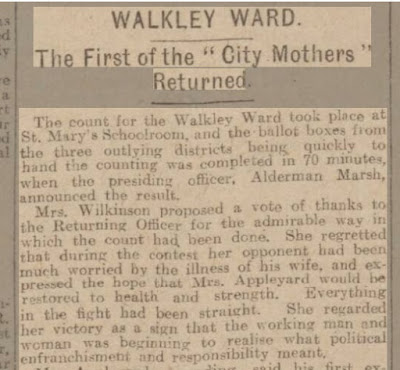
Report on Gertrude Wilkinson's successful election to Sheffield
City Council in November 1919
(Sheffield Daily Telegraph, 3 Nov 1919 p. 8)
After the results for the Walkley Ward were declared at St Mary’s Schoolroom (where the ballot boxes were counted) with Wilkinson triumphing over her older and better-known rival with a majority of 1,174, she addressed a large crowd assembled outside with a stirring speech. She stated how: “in the past they had heard a lot about the City Fathers, but now Walkley had the honour of returning the first City Mother”Wilkinson also pledged to “do her best to watch the interests of the women and children, and to represent the interests of all the people of Walkley”.

So what was the background to this remarkable young lady who managed to defy convention and surmount the substantial barriers facing women at the time to become, in her own words, the first “City Mother” for Sheffield?

Wilkinson came from modest family circumstances: she was born Gertrude Elsie Clarke in Sheffield in 1884, second daughter and one of four surviving children of John Thomas Clarke (1848-1915), a railway porter (who would end up dying in the Ecclesall Bierlow Union Workhouse) and his wife Annie Susanna (c.1859-1923). The family lived at Houghton Street in the industrial Brightside district at the time of the 1891 census but later settled in the Upperthorpe district of Sheffield.  

Gertrude Clarke trained as a teacher, beginning her career as a 'pupil teacher' at Red Hill Wesleyan School in 1899 before teaching at the Lancasterian Council School and later Neepsend Council School in Sheffield. An avowed socialist, as a young teacher she began campaigning against inequality and pressing for greater rights for the working classes and women as evidenced in letters she had published in the local press. In 1907, she joined the newly formed Sheffield Fabian Society and became the organisation’s secretary.

Councillor Gertrude Wilkinson, pictured in
Sheffield Year Book 1920
(Sheffield Local Studies Library: 032.74 SST)
Having resigned from her teaching post at Neepsend Council School at the end of August 1911, on 2nd September 1911, Gertrude Clarke married Cuthbert George Wilkinson (born 1886), a mining engineer, second son of Rev. Christopher George Wilkinson (1855-1929) of Launceston, Tasmania. The couple set up home on Priory Terrace in the Sharrow district of Sheffield and the marriage enabled the new Mrs Wilkinson to step away from teaching and focus fully on her interests in socialism, workers’ and women's rights and local political campaigning.

During the First World War, Wilkinson became chair of the Sheffield Branch of the National Federation of Women Workers, where she fought for fairer wages and better working conditions for women, calling for pay parity with men who undertook the same work. She also represented women munition workers at sittings of the Sheffield Munitions Tribunal during the war and helped those who had been mistreated/dismissed unfairly by their employers gain compensation.  

Other posts held by Wilkinson, which helped bring her into the public eye, included becoming secretary of the local branch of the Women’s Labour League, vice president of the Labour Party in Sheffield and a prominent member of the Sheffield Trades and Labour Council (becoming the organisation’s president by 1919) where she continued to press the case for greater workers’ rights and fairer pay. She helped oversee the amalgamation of the two key Labour bodies: the Sheffield Trades and Labour Council and the Sheffield Federated Trades Council and she was elected first president of the newly inaugurated body, the Sheffield Federated Trades and Labour Council, in July 1920, despite being the only female officer on the Council.

After her election to the Sheffield City Council in 1919, the Sheffield Daily Telegraph (11 November 1919 p. 6) reported how Wilkinson “will go down in history as the first lady member of the Council to speak in the Town Hall”. According to the report, her speech, which took place in front of a packed public gallery, was delivered “with a quiet charm and refinement that showed that the debating power of the Council has been strengthened”. Later that same day, Councillor Eleanor Barton followed Wilkinson with a speech of her own at the Town Hall. Although praising the efforts of both new female members of the Council, the Telegraph rather patronisingly reported how veteran Council alderman and Liberal leader Sir William Edwin Clegg (1852-1932) “went out of his way to win the hearts of the ladies by paying them a pretty compliment on their speeches”, an illustration of the challenges the women faced in order to get taken seriously in the Council corridors of power.

Presentation of a "gold wristlet watch"  to retiring Councillor Gertrude
Wilkinson in June 1923 as thanks for her services to the city of Sheffield
(Sheffield Daily Telegraph, 21 Jun 1923 p.5)
From the time of her election as Sheffield City Councillor in November 1919 onwards, Wilkinson served on the Council’s Education Committee. Having worked as a teacher in Sheffield for over a decade, Wilkinson brought valuable first-hand classroom experience to the Education Committee and was committed to educational reform to help the most disadvantaged in society. She also served on the Council’s Health, Hospitals and Distress Committees. Her knowledge, drive and desire to make a positive difference for the people of Sheffield won her widespread admiration from colleagues on the Council on all sides of the political divide. 

In June 1923, still only 39, Wilkinson’s Sheffield City Council service came to a premature end when she had to resign her seat due to having to relocate to 'Siam' (modern day Thailand) where her husband had been posted as a mining engineer. Wilkinson’s departure from the Council was widely lamented and she earned glowing tributes from colleagues - even from Council stalwarts outside the Labour Party such as Sir William Edwin Clegg (1852-1932) - which is testament to her personality and political acumen. When paying homage to Wilkinson, fellow Councillor and Labour MP for Attercliffe Cecil Henry Wilson (1862-1945) is reported as saying how “he did not think the Labour Party appreciated what Mrs Wilkinson’s presence in Sheffield had meant to them” and how “she had laid the foundation upon which a greater movement than the one that existed would be built up” (Sheffield Daily Telegraph, 21 Jun 1923 p.5).

Following her departure to South East Asia in the summer of 1923, Wilkinson’s future fate remains something of a mystery. Evidently remaining overseas, she largely disappears from available historical records. Occasionally, for intermittent years between the 1920s and early 1950s, she crops up alongside her husband in surviving UK outgoing ships’ passenger lists, bound for places like Singapore and Australia, indicative of short trips the couple made back to England to see family and friends. By the late 1920s, Gertrude’s husband Cuthbert George Wilkinson is known to have ended up as manager of the Rantau Tin Dredging Co. in the Federated Malay States (present day Malaysia). 

Councillor Gertrude Wilkinson pictured after news
of her retirement from Sheffield City Council was
announced in June 1923
(Sheffield Daily Telegraph, 13 Jun 1923 p.5)
The last record we have been able to track down which relates to Gertrude Wilkinson with any certainty is a ship’s passenger list, which shows her sailing back from a visit to England to Sydney, Australia in November 1952, aged 69, alongside her now retired mining engineer husband, with her occupation recorded as “housewife”. It is believed that Gertrude and Cuthbert George Wilkinson ended up settling in Sydney later in life which is where Cuthbert’s family eventually relocated, having first moved out to Australia in 1890 (with Cuthbert’s father Rev. Christopher George Wilkinson becoming headmaster of the Launceston Church Grammar School in Tasmania).

Regardless of what happened to Gertrude Wilkinson after swapping Sheffield for South East Asia, it is clear that she left her hometown a much better place. She had defied the odds, rising from humble origins to break into the elitist and male dominated world of local politics, overcoming ingrained sexism and prejudice at the time, to become a successful Sheffield politician, advancing the cause of equality and justice and helping to blaze a trail for others to follow.

Universal suffrage in Britain (with men and women given the right to vote on equal terms - over the age of 21) was eventually introduced in 1928, five years after Wilkinson left these shores. The following year, in the November 1929 municipal elections in Sheffield, seven new female Labour Councillors won seats, bringing the total number of female Sheffield City Councillors to 10. Wilkinson would no doubt have rejoiced at this greater representation of women on the Council although she would have recognised there was still some considerable way to go to achieve the equal society she craved.

A century on, it seems an opportune time to remember the first “Sheffield City Mother”, the pioneering teacher who helped to make Sheffield a fairer place and whose life offers a lesson for us all. 
Group of newly elected female Labour Sheffield City Councillors, November
1929, who 
followed in the footsteps of Councillor Gertrude Wilkinson
(www.picturesheffield.com ref. s12604


Note: Further information about the life and political career of Gertrude Wilkinson and her fellow Sheffield City Councillors can be found in collections held at Sheffield City Archives and Local Studies Library (for example in local newspapers, Sheffield Year Books, Sheffield Education Handbooks, Sheffield City Council minutes, Sheffield City Council election fliers/posters, etc.).

Spotlight 9. Monsters


Watch Frankenstein: A National Theatre Production

A new play by Nick Dear, based on the novel by Mary Shelley. Watch Danny Boyle's monster hit Frankenstein with Benedict Cumberbatch as the creature and Jonny Lee Miller as Victor Frankenstein.

The play is streaming for free until 7pm on Thursday 7 May. It is subtitled and the running time is 2 hours. 

Watch the play


Tales of Valhalla

The world of Norse mythology and legend is full of mystery and monsters. In this podcast, Martyn Whittock, author of Tales of Valhalla introduces the Norse people and takes us on a fascinating tour of their culture and myth.

Listen to the podcast


Monsters in the eLibrary

The eLibrary is bursting with stories of about monsters including familiar favourites and new bestselling fiction and non-fiction.  Why not listen to a story while doing chores, get lost in an ebook, or even try a comic.


Discover the eLibrary 


Book Monsters - Children's Book Reviews

Check out this brilliant book blog from one of our own.  Book Monster Ally, with the help of some friendly Book Monsters sniff out the best picture books, young readers and young adult books to review.

Visit the blog


Monster Activities for Kids

Looking for inspiration for what to do with the kids.  Take a peek at these 20 Monster themed craft activities

View activities


Julia Donaldson read The Giant Jumperee

Children's superstar author reads the Giant Jumperee, written by Julia and illstrated by Helen Oxenbury.  the animals are scare to go near the burrow, but is it really a monster scaring them all away?  Why not join Julia in singing the Giant Jumperee song?

Watch the video


Monday, May 4, 2020

Spotlight 8. Hope


Poems of Hope and Resilience

In this selection of poems compiled by the Poetry Foundation, hope takes many forms: an open road, an unturned page, a map to another world, an ark, an infant, a long-lost glove that returns to its owner. Hope is deeper than simple optimism, and more mysterious, delicate, and elusive. It is a feeling we must develop and cultivate, yet worth the effort, for it can also foster the determination and grit to see us through difficult times, both now and ahead.

Read the collection


Book of Hopes

Completely free for all children and families, the extraordinary collection of short stories, poems, essays and pictures has contributions from more than 110 children’s writers and illustrators, including Lauren Child, Anthony Horowitz, Greg James and Chris Smith, Michael Morpurgo, Liz Pichon, Axel Scheffler, Francesca Simon and Jacqueline Wilson.

The collection, published by Bloomsbury, is dedicated to the doctors, nurses, carers, porters, cleaners and everyone currently working in hospitals.


Read the Book of Hopes


May the Fourth be with you!

Sorry, we just couldn't resist.  It is Star Wars day!  Check out Star Wars Episode 4 (A New Hope), from our huge collection of free eComics available to Sheffield library members.

Search the eLibrary


Anything but Silent - The British Library Podcast

Buzzing, creative, brave. Places of sanctuary, freedom, and hope. Libraries don’t just keep our stories safe; they’re where new stories begin. Why not dip into this series of podcasts from the British Library and meet people around the world making amazing things happen in them.  It’s full of stories about how books, libraries and community can change the world for the better.  It’s full of hope and humanity, and well worth exploring.

Listen to the podcasts


Creativity during Corona - Hope

Each morning during lockdown, we’ve been posting daily creative prompts on Facebook and we’ve been overwhelmed by the response from people creating their own poetry and artwork.  We look forward to showcasing some of this work during an exhibition at the Central Library when life returns to normal.

Today, Claire from the Central library has picked a poem about hope that speaks to her.  Perhaps it will speak to you too.

You could simply read the poems then close…or take a look at the prompts on our Facebook page and send us your own thoughts, notes, journal piece, poem, short story,  drawing, paintings, photographs, knitting, sewing, or  songs….  Enjoy.


Molly and Mr Minto's Lockdown

Finally, check out this video of author Wendy Meddour reading her brand new story, Molly and Mr Minto's Lockdown.  It's a story about hope, creativity and community.  We love how it reflects some of the wonderful true stories of people coming together in their communities across the country.

Watch the video